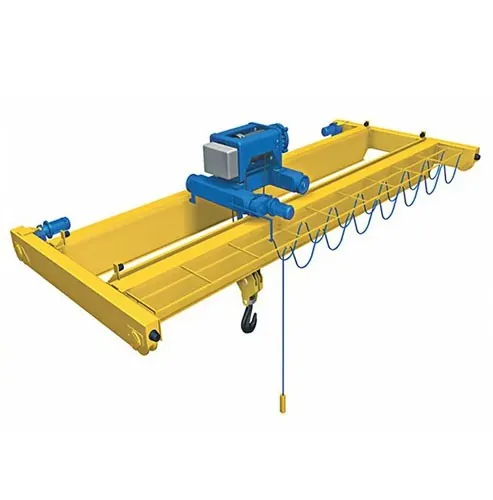
It is the first question in almost every EOT crane enquiry: single girder or double girder? Both carry a hoist across a bay on a bridge that travels the length of the building. The difference is in how the hoist is carried — and that changes capacity, span, hook height, weight and cost.
How they are built
A single girder EOT crane has one main girder. The electric wire rope hoist hangs from its bottom flange and travels along it. The girder is either a rolled steel I-beam with a C-channel capping on top for lateral stiffness, or a box section fabricated from plate.
A double girder EOT crane has two girders. The hoist is part of a crab that runs on rails on top of the girders. For higher capacities and longer spans, fabricated box girders are the usual choice.
Side-by-side comparison
| Factor | Single girder | Double girder |
|---|---|---|
| Typical sweet spot | Generally preferred up to ~15 t and ~20 m span | Higher capacities and longer spans (our range: up to 50 t, 30 m) |
| Hook height | Hoist hangs below the girder, so some lift is lost | Hook rises between the girders — minimum headroom |
| Crane weight | Lighter — less load on columns and runway | Heavier — runway and building must be designed for it |
| Cost | Lower purchase and installation cost | Higher, but best value at high capacity and duty |
| Maintenance access | Hoist reached from a ladder or platform | Walkways on the girders give easy access to the crab |
| Girder limits | Rolled beams limited by available sizes and lengths | Box girders designed for the span and load |
When a single girder crane is the right choice
- Loads up to around 15 t with spans up to about 20 m
- Workshops, stores, assembly and machining bays
- Existing buildings where column and runway loads must be kept low
- When budget is the main constraint
If hook height is tight, a low headroom hoist can recover much of the lift a standard underhung hoist would lose.
When you should choose double girder
- Capacities above about 15 t, up to 50 t
- Long spans where rolled beams are not available or deflect too much
- Maximum hook height under a fixed roof
- High duty classes (M6–M8) in steel mills, foundries and heavy engineering
- When you need walkways for maintenance or an auxiliary hoist
Same standards either way
Whichever you choose, Electro Crane EOT cranes are designed and manufactured in accordance with IS 3177 and IS 4137, with structures to IS 807 and IS 800, duty classes M5 to M8, and load testing at 125% of rated capacity in our own workshop.
Send us your capacity, span, height of lift and duty, and we will recommend the most economical configuration.
FAQs
Is a single girder crane cheaper than a double girder crane?
Generally yes, because it uses less steel, has simpler end carriages and imposes lighter loads on the building.
What is the maximum capacity for a single girder EOT crane?
Single girder designs are generally preferred up to about 15 t and 20 m span; above that a double girder design is usually recommended.
