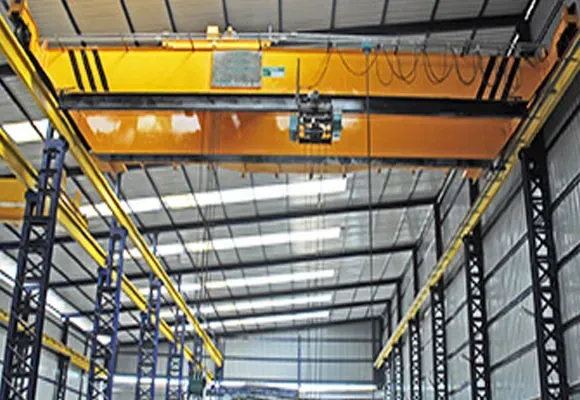
“Overhead crane” covers a whole family of machines. Choosing the right type first saves money and avoids building changes later. Here are the main types we manufacture, and where each one fits.
1. Top-running EOT crane
The classic Electrically Operated Overhead Travelling crane runs on rails mounted on top of gantry girders along the building. Available as single girder or double girder, it covers the widest range of capacities — our range is 500 kg to 50 t with spans up to 30 m and duty classes M5 to M8.
2. Underslung (under-running) crane
An underslung EOT crane runs on the bottom flanges of runway beams, usually suspended from the roof. It needs no runway columns, can have cantilevers at one or both ends to reach close to walls, and suits buildings with limited headroom. Typical range: 0.5–15 t, span up to 25 m.
3. HOT crane (hand operated)
A hand operated overhead travelling crane uses hand chains for hoisting and travel. No electricity needed — ideal for occasional lifts, remote sites and hazardous areas. Capacities 500 kg to 50 t, duty M4.
4. Goliath (gantry) crane
A goliath crane carries its bridge on legs running on ground-level rails. Cheaper rails make long outdoor tracks economical. Outdoor cranes are checked for stability under storm conditions and fitted with storm anchors.
5. Semi goliath crane
A semi goliath crane is a hybrid: one end runs on a high-level gantry (often part of a building), the other on a leg at ground level. Perfect for yards alongside a building or partial-span coverage indoors.
6. Jib crane
A jib crane swings an arm around a pillar or wall. It serves one workstation or machine. Capacity 250 kg to 5 t, swivel 180°, 270° or 360°, manual or electric slewing.
7. Flame proof crane
For refineries, chemical and pharma plants, a flame proof crane uses flame proof motors, brakes, switches and panels. Ours suit Zone 1 and Zone 2, gas groups IIA, IIB and IIC, capacity 500 kg to 20 t.
Quick selector
| If you need… | Consider |
|---|---|
| Full-bay lifting indoors, any capacity | Top-running EOT (single or double girder) |
| No runway columns / low headroom | Underslung crane or low headroom hoist |
| Outdoor yard | Goliath or semi goliath crane |
| One machine or workstation | Jib crane |
| No power available / occasional lifts | HOT crane |
| Explosive atmosphere | Flame proof crane or hoist |
Still unsure? Send us your building drawing and load details — we'll suggest the type that fits best.
FAQs
What is the most common type of overhead crane?
The top-running EOT crane, in single or double girder form, is the most widely used overhead crane in industry.
What is the difference between a gantry crane and an overhead crane?
An overhead (EOT) crane runs on elevated rails supported by the building; a gantry crane stands on its own legs running on ground-level rails.
